
Google Inc is currently in talks with a number of start-ups with unique and innovative business models, particularly in areas like voice and SMS-based advertising, to expand its presence in the country, an official close to the development said.\n\n

Benchmark indices ended on a flat note on Thursday as fag-end selling wiped out intra-day gains amid weak global trends. The BSE benchmark Sensex slipped 8.03 points or 0.02 per cent to settle at 53,018.94. During the day, it had gained 350.57 points or 0.66 per cent to 53,377.54. Similarly, the broader NSE Nifty fell 18.85 points or 0.12 per cent to close at 15,780.25.
Vodafone CEO Arun Sarin, who engineered the acquisition of Hutch-Essar in India, has accused unsuccessful rival bidders of trying to derail the deal and sought transparency from Indian regulators in M&A approvals.

Ajit Mishra, vice president, Research, Religare Broking, answers your stock market queries.
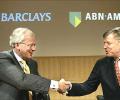
In the world's biggest-ever financial services takeover, the United Kingdom's third largest bank Barclays will buy out Dutch rival ABN Amro Holding for $91 billion (Euro 67 billion), creating the world's fifth largest bank.
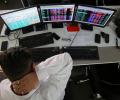
Gold as well as crude oil prices surged, with the latter even crossing the $103 per barrel mark. The domestic stock market opened deep in the negative territory, tumbling over 1,700 points and eroding investors' wealth by more than Rs 8 lakh crore in less than an hour of start of trade on Thursday.
An unprecedented 740 Indian companies from industries as diverse as casting to agro-chemicals to coffee bars to regulars such as software and banking were involved in mergers and acquisitions and private equity deals worth $26.7 billion.

M&M was the top gainer in the Sensex pack, rallying nearly 6 per cent, followed by Bajaj Auto, Titan, Bajaj Finance, HDFC Bank and PowerGrid.

In his opening remarks at the talks, Defence Minister Rajnath Singh asserted that India is confident of overcoming the challenges with a strong political will and an inherent capability of its people.

Tata Steel was the top gainer in the Sensex pack, rallying nearly 4 per cent, followed by Bajaj Finance, M&M, Bajaj Finserv and Reliance Industries. NSE Nifty advanced 33.95 points to a fresh high of 16,563.05.

IndusInd Bank was the top laggard, tumbling over 7 per cent, followed by Bajaj Finance, M&M, Tech Mahindra, TCS and Tata Steel.

Cross previous high of $72 billion in 2007 as Indian promoters overcome the selling taboo. Abhineet Kumar reports from Mumbai.
India ranks second in capital market inflows and fourth in merger and acquisition deals in Asia Pacific (including Japan), as deals worth $65.033 billion were reported in the first eight months of calendar 2007.
'Some funds may be redirected towards "safe" countries'
The Sensex came under fag-end selling pressure to close in the red for the sixth straight session on Friday as risk-off sentiment prevailed amid unabated selling by foreign institutional investors and concerns over inflation. The 30-share BSE benchmark pared all intra-day gains and declined 136.69 points or 0.26 per cent to end at 52,793.62. During the day, it had rallied 855.4 points or 1.61 per cent to 53,785.71. On similar lines, the broader NSE Nifty dipped 25.85 points or 0.16 per cent to settle at 15,782.15.
Finance divisions and CFOs should also "feed" information and insights into the rest of the organisation
Meet Arunkumar Ramanlal Gandhi. The head of the M&A activities in the Tata Group, who called up Tata to convey Tata Steel's victory.

Bajaj Finance was the top laggard in the Sensex pack, plunging around 6 per cent, followed by IndusInd Bank, SBI, M&M, Axis Bank, Bajaj Auto and ICICI Bank. NSE Nifty sank 229.55 points to 14,637.80.
Corporate India has put together a whopping $20 billion (Rs 90,000 crore) so far this year to fund its merger and acquisition bills abroad, surpassing all previous full year totals.
IT consulting and services provider Patni Computer Systems Ltd on Tuesday announced the appointment of Loek van den Boog as an independent director on its board.
Amidst global private equity investment firms making a beeline for India and the growing dominance of PE players in the M&A deals executed by India Inc, US-based banking giant Bank of America has pulled curtains on its private equity division in Mumb

Dilip Shanghvi founded Sun Pharma in 1983.
The outlook on Mahindra and Mahindra (M&M) has been changing since its tractor business hit a speed-breaker. Analysts say there are no real triggers for its shares to move up in the near term.

Axis Bank was the top loser in the Sensex pack, falling around 3 per cent, followed by SBI, M&M, Bajaj Finance, ITC, HDFC Bank, HCL Tech and IndusInd Bank.

Tivoli has turned out to be the best-selling vehicle from SsangYong in its 62-year history, Ajay Modi reports from New Delhi.

'I see a virtually zero impact on the sales of new vehicles with this move,' said an expert

Australia batsman Steve Smith has had plenty of ups and downs in his career which probably prepared him for when his evening plans were ruined on Thursday after being trapped in an elevator between floors for 55 minutes before he was rescued.

M&M was the top laggard in the Sensex pack, shedding around 4 per cent, followed by Bajaj Finance, ITC, Sun Pharma, Bajaj Auto, Bajaj Finserv and TCS. On the other hand, Asian Paints, ONGC, Titan, L&T and Axis Bank were among the gainers.

The keenly-awaited Mahindra Thar 2020 was finally unveiled on August 15, 2020. Here are the first images of one of the finest off-roaders!

From the 30-share pack, Infosys, Tech Mahindra, TCS, HDFC, HDFC Bank, Wipro and HCL Technologies were among the major laggards in early trade. Nifty tumbled 314.95 points to 17,160.70.

IndusInd Bank was the top loser in the Sensex pack, tanking over 8 per cent, followed by Bharti Airtel, Tata Steel, ICICI Bank, M&M, Maruti, Axis Bank and ONGC. On the other hand, Kotak Bank, Infosys and TCS were the gainers.

HDFC Bank was the top loser in the Sensex pack, shedding nearly 2 per cent, followed by HDFC, Bajaj Finance, NTPC, Maruti, Kotak Bank and PowerGrid. The NSE Nifty fell 24.30 points to 18,044.25.

M&M is keen to increase the number of factories in the Africa region and plans are afoot to have one each in Sudan and Kenya.

Total FDI from China in India so far is about $1.24 billion

Stock markets squandered early gains but managed to end in the green on Friday, propped up by heavyweight Reliance Industries which announced another stake sale deal for its digital platform. A strengthening rupee and firm global cues also supported the domestic bourses, traders said.

HUL was the top gainer in the Sensex pack, spurting around 3 per cent, followed by Infosys, M&M, ITC, SBI, IndusInd Bank, Bajaj Finance, Asian Paints, TCS and Bharti Airtel. On the other hand, Titan, PowerGrid and NTPC were among the laggards.

National brands prefer the acquisition route since the southern market is culturally different, reports T E Narasimhan from Chennai.
 © 2026 Rediff.com - Advertise with us - Disclaimer - Privacy Policy - Sitemap - Feedback - About us - Terms of use - Grievances